
Wiki editors are people, and no two people are alike. Muppet Wiki has been cultivated by a wide range of individuals from diverse backgrounds with different temperaments, but we all share the same desire: to make the best possible resource of information about the Muppets. To do that, we need to work together in the spirit of collaboration to ensure we maintain a healthy working relationship. A key component of that is communication; it's also important to lay the ground rules on what to do when editors fail to work together amicably, and how to deal with vandalism, refusal to adhere to wiki policy, and blocking users from editing.
Assume good faith
To assume good faith is a fundamental principle on any wiki. As we allow anyone to edit, it follows that we assume that most people who work on the project are trying to help it, not hurt it. If this weren't true, a project like Muppet Wiki would be doomed from the beginning.
When you disagree with someone, remember that they probably believe that they are helping the project. Consider using the Forum to explain yourself, and give others the opportunity to do the same. This can avoid misunderstandings and prevent problems from escalating. Especially, remember to be patient with newcomers, who will be unfamiliar with wiki culture and rules.
A newcomer's behavior probably seems appropriate to them and a problem usually indicates unawareness or misunderstanding of wiki culture. It is not uncommon for a newcomer to believe that an unfamiliar policy should be changed to match their experience elsewhere. Similarly, many newcomers bring with them experience or expertise for which they expect immediate respect. Behaviors arising from these perspectives are not necessarily malicious.
Assuming good faith is about intentions, not actions. Well-meaning people make mistakes, and you should correct them when they do. What you should not do is act like their mistake was deliberate. Correct, but don't scold. There will be people on Muppet Wiki you disagree with. Even if they're wrong, that doesn't mean they're trying to wreck the project. There will be some people you find hard to work with. That doesn't mean they're trying to wreck the project either; it means they annoy you.
Assuming bad faith
If you assume bad faith, several things may happen:
- Personal attacks: Once you've made a personal attack, the target will probably assume bad faith. The edit war will get even uglier. People, like elephants, rarely forget.
- Losing sight of the NPOV (neutral point of view) policy. The ideal is to make articles acceptable to everyone. Consider figuring out why the other person felt the article was biased. Then, if possible, try to integrate their point, but in terms you consider neutral. If each side practices this, they will eventually meet at NPOV, or a rough semblance of it.
Correcting someone's error (even if you think it was deliberate) is better than accusing them of lying because the person is likely to take it in a good-natured fashion. Correcting a newly added sentence that you know to be wrong is also much better than simply deleting it.
This guideline does not require that editors continue to assume good faith in the presence of evidence to the contrary. Things which can cause the loss of good faith include vandalism, personal attacks, and edit warring.
Vandalism
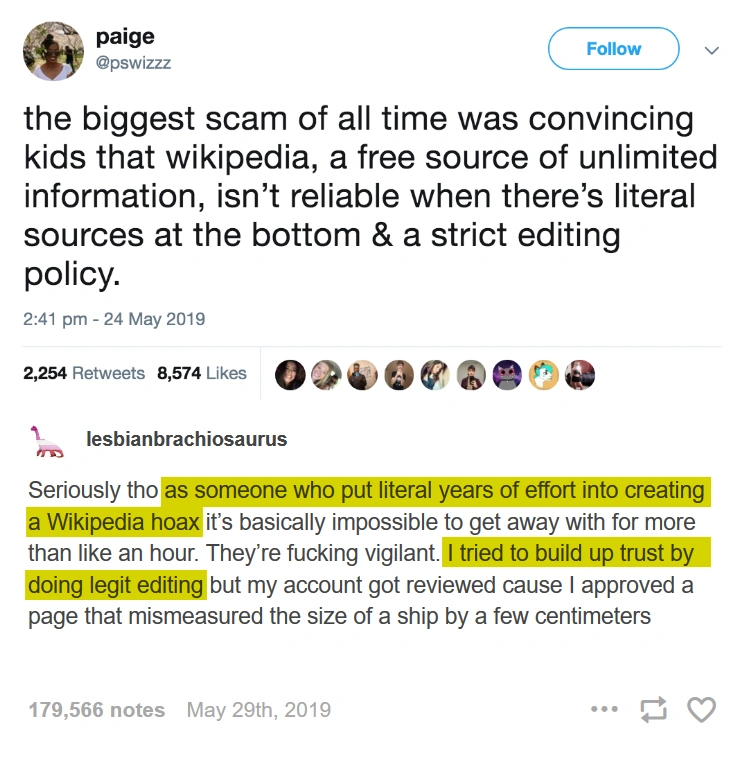

A Tumblr blogger admitting to spending years building up trust for the purposes of hurting Wikipedia's credibility. [1][2]
Vandalism is an addition, deletion, or change to content made in a deliberate attempt to compromise Muppet Wiki's integrity. The most common types of vandalism are replacing text with obscenities, blanking pages, or adding nonsense.
Any good faith effort to improve the wiki, even if it's misguided or incorrect, is not vandalism. However, established editors and admins should be vigilant of subversive users who build trust over time in order to undermine the wiki's credibility. This is more common on Wikipedia, but can be tough to spot on a smaller wiki, so approaching suspects should be handled with care.
Vandalizing pages is a violation of Muppet Wiki policy. Wikipedia's policy is to give vandals three warnings, and then block them for a short period of time. We do things differently here, because Wikipedia has 26,000 active contributors, and they can afford to spend time chasing after vandals. We're a niche wiki, with a dedicated but small team of contributors, and we don't have the time or the patience to play whack-a-mole with the vandals.
Fix vandalism
When you see that a page has been vandalized, please revert the page to the previous version. Reverting the vandalism quickly helps to protect the wiki, and it sends a message to the vandal that his or her efforts have been wasted.
- Click the history tag on the page, and you'll see a list of all of the previous versions of the page.
- You can see any version by clicking on the date. Click on the most recent version before the vandalism.
- Click on "edit", and you'll see a regular edit page, plus a warning that says that you're editing an out-of-date revision of the page.
- Hit save, and the unvandalized version will become the current version of the page again.
Check the vandal's contribution history
It can also be helpful to click on the vandal's IP address or username to see their contribution history. They may have vandalized other pages, too, and you can revert those.
Don't tease the vandals
Vandalism is irritating, especially when you can tell that it's the same vandal who's come back more than once. Please resist the urge to let the vandal know how annoyed you are. Don't write anything in the edit summary except "vandalism", and don't post anything on the contributor's talk page.
Vandals are looking for two different kinds of satisfaction: the pleasure of defacing our work, and the pleasure of watching us get angry about it. When you revert the vandalism and ignore the vandal, you take all the pleasure away; the vandal will get bored and move on to pulling the legs off of spiders or whatever else they enjoy.
Blocking

The administrators of Muppet Wiki are not babysitters. Over the years, we've been contacted by blocked editors and their parents asking why their editing privileges had been revoked. We run this wiki in our spare time as a hobby. We take our work seriously, and we'll protect the integrity of our content with a firm hand. We're also here to enjoy ourselves and work harmoniously with a community who's willing to follow the established rules and help make the wiki a better resource for everyone. We're happy to assist helpful editors in becoming better contributors, but we're not in the business of allowing unhelpful editors to run rampant; we have better things to do. We've been doing this for over 20 years and we've gotten very good at identifying signs of an individual who's not willing to be a part of the team. These cases often lead to being uninvited to the party to make room for those who are productive members. We encourage folks to divert their energy to other avenues of interest such as social media groups, blogs, and discussion forums elsewhere.
Basic principles
- Nobody said collaborative writing was easy. More people = more problems, but opening up the wiki for anyone to edit is how you write 20,000+ pages about the Muppets in four years. More people = exponentially more information.
- Every new contributor is a potential new friend, and we should treat them that way as much as possible. With some exceptions, we should assume that everyone who edits the wiki is trying to help.
- We're frustrated by the returning vandals, and want to get rid of them as efficiently as possible. We don't want to "give people chances" when we know who they are, and they're just wasting our time and energy.
- The biggest reason that people don't contribute to wikis is that they're afraid they'll mess something up or make a mistake. Everyone who actually clicks the edit button for the first time is taking a leap of faith.
- Having your first edit reverted is a disappointment. It leaves a bad taste in your mouth and makes you not want to make a second edit.
- People who contribute for the first time don't know our rules and formats, and we shouldn't expect them to. If they stick around, we can teach them how things work.
Situations
- Returning vandal — Someone we've seen before, an obsessive kid who keeps doing the same dumb things over and over.
- Immediate block, and revert all edits. Fandom Staff have access to the CheckUser tool which can look up a user's IP address. If someone's used the same IP address for multiple accounts, we can block the IP address. (If you're not an admin: revert all edits, and let an admin know.) IP blocking is slightly less effective given the rise of dynamic IPs and the widespread use of VPNs, but it's an option.
- New vandal — Someone we haven't seen before. Does something obviously terrible, like fill the page with curses.
- Immediate block, and revert all edits.
- New helpless mistake — Does something pretty bad, like blank a page or screw up headings, which could be vandalism or could be a helpless newbie mistake.
- Revert. Leave a message on their user talk page telling them that you reverted the edit, and asking if you can help them figure out how to edit the wiki. If they don't respond and do it again: block.
- New bad fact — Adds a sentence that isn't true, or unsourced. This might be an honest mistake, or it might be testing the boundaries of what happens when you add the wrong thing. (Unfortunately, it's often hard to tell the difference.)
- Revert. Act as if they meant well, even if you're not sure whether they did or not. Leave a message telling them that you reverted their edit, and explaining that we need to source facts so that we have the most accurate information. Invite them to ask you if they have questions. If they don't respond and do it again: block.
- New guidelines mistake — Makes an edit that violates one of our guidelines or formats.
- Ditto as above.
- Plagiarism — Copying text from somewhere else may be an honest mistake, but repeated plagiarism is not acceptable.
- Post a warning with a link to Muppet Wiki:Plagiarism; block if necessary.
Harassment
Users who have had their editing privileges revoked are not welcome back. As explained previously on this page, an unwillingness to follow the rules and/or communicate with others is a demonstration of one's inability to work on this project in good faith. You're not welcome back. Pestering those responsible for your dismissal is harassment. Those who engage in stalking — on and off wiki — will, if necessary, be reported to the proper authorities.
(Additionally, editors found to be making changes on the wiki at the request of blocked users will be subject to scrutiny. We recognize that there is no way for unsuspecting editors to know the history of problem users, but we urge these individuals to use discretion: ask yourself, why is this person requesting that I make edits for them? In these cases, admins will review the situation and inform the good faith editor, with action to be taken if notice is not heeded. In other words, if you're a blocked user asking someone else to make edits for them, you are jeopardizing another person's good standing.)
Your ability to edit a wiki is a privilege, not a right. If we didn't hold this project to a set of standards agreed upon by the community, it wouldn't be the dependable resource that it is.
If you're a parent or caretaker of a minor or an individual with cognitive disabilities, we encourage you to help your dependent find something else to focus on. That could be some other online activity or community engagement, but Muppet Wiki is not an outlet for the kind of focus that requires special attention.
We do our best to help everyone learn how to be productive members here, but please recognize that our rules are for the benefit of the community and the content we've all worked so hard to build and maintain. We believe this to be a reasonable request regardless of one's cognitive state. In other words, someone's age, sex, gender, disability, ethnicity, language, etc, is no excuse for not following the rules.