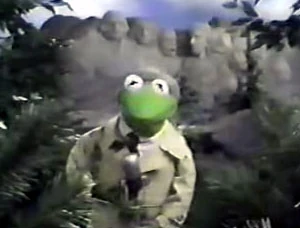

Kermit with Mount Rushmore in 1987.
Muppet Minute[1] was the concept for a regular segment on 60 Minutes in 1983, wherein the Muppets would bring to life the kind of situation, humor, and commentary of the typical editorial cartoon.
Jim Henson had an initial meeting with executive producer Don Hewitt, as the program's staple Andy Rooney was considering retiring. Hewitt had long desired to have a political cartoon-type segment on the show since its inception. Recalling the humorous feature about The Muppet Show that aired on 60 Minutes in 1979, he believed the Muppets' brand of comedy might work best in a new segment to fill Rooney's expected absence.[2][3] Henson tapped frequent collaborator Joseph A. Bailey to help develop material for the potential segment.
Throughout the spring and summer of 1983, Henson and Bailey worked on various concepts for the feature, with such ideas as a literal two-faced individual, a "mole" in the Pentagon, and the Statue of Liberty come to life.[1] In August, the pair submitted proposals to the 60 Minutes staff with scripts involving Kermit the Frog, Fozzie Bear, Gonzo, Dr. Bunsen Honeydew, and the Muppet version of Mount Rushmore (originating from The Muppet Show: Sex and Violence).[4] One such routine by Bailey, titled "The Bomb," had Kermit interview inventor P.R. Flack, creator of an explosive device capable of leveling the whole of the United States in mere seconds (allowing the nation to save face by destroying itself rather than allow any alien enemy the opportunity).[2]
By September, fellow Sesame Street writer Tony Geiss had been brought on board to write new sketches starring Mount Rushmore, acting as the sole focus of the weekly feature. Rather than simply trading corny, politically-adjacent jokes as in their debut special, the stone heads would comment on current topics of pollution, new laws, and Vanessa Williams becoming the first Black Miss America (though George Washington continues to be the slowest on the uptake). Kermit (in reporter mode) would appear to provide a brief introduction to the Presidential group. Henson and his team took to the CBS Studios on September 28 to record the initial batch of four sketches.[4] In October, Henson's involvement in the program began to be reported on by the press, which misinterpreted the concept as literal animated segments without Muppets.[3]
However, Henson was dissatisfied with the results of the September shoot. A second taping session was planned for November 7,[5] but was postponed until the 30th.[4] In the meantime, Geiss prepared a new quartet of sketches. For these segments, Henson was joined by performers Peter Baird, Neil Gallagher, Brian Muehl, and Fred Newman as the Presidents. Even with the revised segments, the 60 Minutes producers could not find an appropriate slot for them, and all the material was ultimately left unaired.[1] Andy Rooney did not retire as initially anticipated at the time, and remained on the show until 2011.
While the feature was abandoned, the premise of Reporter Kermit paired with the sentient monument was repurposed for some 1987 PSAs for the National Wildlife Federation. Years later in 1992, the Muppets would be featured in a series of weekly sketches for Good Morning America, fulfilling the original concept of the characters providing a humorous spin on topical events within a television news magazine format.
Mount Rushmore skits
The following are summaries of material written by Tony Geiss, including sketches that did not end up getting recorded at all. This material originates from the Tony Geiss papers at the Beinecke Rare Book & Manuscript Library, Yale University.
The following sketches were recorded during the first taping session on September 28, 1983:[4]
- America's Cup
- Miss America: Reacting to Vanessa Williams's recent crowning as Miss America, Lincoln can hardly believe it's taken so long for a black woman to earn the title. While wondering what progress this means, an empty space on the mountain besides the heads speaks up with a female voice, telling them to "Watch this space, baby!"
- New TV Season: The Presidents peruse TV Guide to see what programs are coming this season. They are dismissive of such programs as Just Our Luck and Manimal, while agreeing there might be promise in Mr. Smith. Washington doesn't bother with TV, until he learns a miniseries about his life is on the schedule.
- TV Anchormen: The Presidents think the reputation of highest office in the land now belongs to TV anchormen like Dan Rather and Walter Cronkite. Washington remarks that he prefers the trust and dignity of the town criers of yore (since they wore sweaters).
- In an alternate draft, Jefferson stresses what made Paul Revere such a credible source of news. The others don't necessarily agree, until they're reminded that Revere wore a sweater.
The following sketches were recorded during the second taping session on November 30, 1983:[4]
- Acid Rain: Washington is concerned about the affects of acid rain, citing the corrosion of the Statue of Liberty and what that means for the symbols of our nation (not to mention the cost). Suddenly, a downpour begins and Washington worries his nose is now shrinking.
- Greenhouse Effect: On a chilly day, Roosevelt believes that due to the greenhouse effect, days will be always be sunny, warm, and underwater (from the melting ice caps). He puts much faith in the science behind it, despite a rainfall beginning that contradicts the supposedly accurate weather forecast.
- New Year's Toast: The Presidents (slightly tipsy from the New Year's Eve celebration) look back at 1983. Upon realizing how poorly things seem to be going in the country, they decide to toast to the wonderful new year of 1985.
- Telephone Trust: Roosevelt is pleased to hear the telephone trust has been busted, but his fellow Presidents are certain problems will arise from this. When Roosevelt asks why Congress would ruin such an effective measure, Lincoln remarks, "Teddy...it was too good."
Additional sketches written, but not recorded include:
- Congress Not on Drugs: The Presidents react to a new investigation determining that none of the sitting members of Congress are on drugs. The carvings aren't sure they agree when they hear about all the poor financial decisions they're making.
- Mount Rushmore Gives Thanks: On Thanksgiving, the Presidents comment on all the harsh realities facing the current President, and agree that they're most thankful they no longer occupy office.
- Non-Smokers Rights: The Presidents feel that there's a "right" for everybody these days, even non-smokers.
- The Presidents Wives: Roosevelt balks at a recent advertisement using the likeness of Ethel Kennedy, and they all reflect how their own names have been co-oped for products. Washington concludes that this is merely "the price of greatness."
See also
Sources
- ↑ 1.0 1.1 1.2 Jim Henson's Red Book: 9/–/1983 – ‘Working on Mt. Rushmore for 60 Minutes.’
- ↑ 2.0 2.1 Memoirs of a Muppets Writer, pages 263-266
- ↑ 3.0 3.1 The Evening Independent "Cartoons on '60 Minutes'" October 10, 1983
- ↑ 4.0 4.1 4.2 4.3 4.4 Personal communication between Shane Keating and Karen Falk
- ↑ Jim Henson's Red Book: 11/7/83 ‘VTR Mt. Rushmore for 60 Minutes.’
