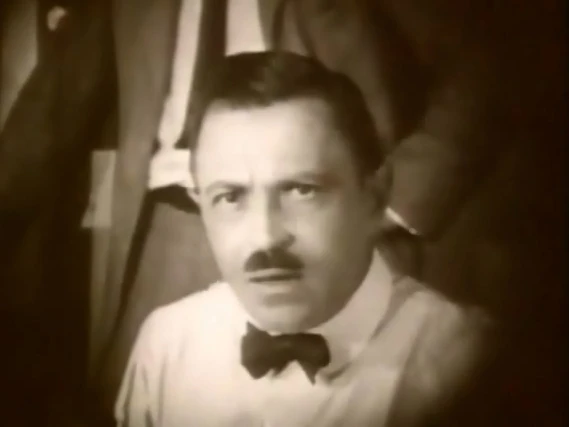

Max Fleischer, as seen on Muppet Babies
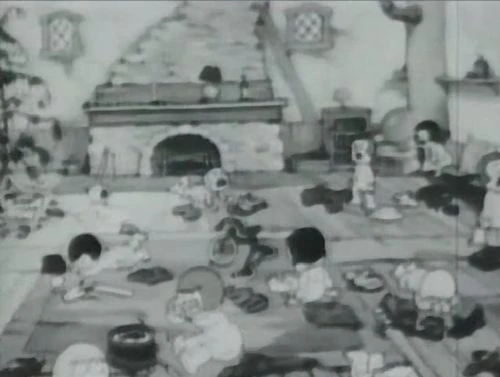

Christmas Comes But Once a Year, a color Fleischer short but seen in black and white on Muppet Babies
Max Fleischer (1883-1972) was an animator, director, and producer whose Fleischer Studios was one of the leading producers of theatrical animated shorts in the 1920s and 1930s, predating the arrival of Walt Disney. Fleischer helped pioneer the use of rotoscoping (filming and tracing footage of live actors) in its Out of the Inkwell series with Koko the Clown, and was granted the patent on the concept in 1917. He and brother Dave (the original model for Koko, and credited director of most of the studio's output) began their careers at J. R. Bray's studio, establishing their own concern in 1921. Following early failed attempts at self-distribution, Paramount Pictures became Fleischer's distributor in 1927.
The hallmarks of the Fleischer cartoons in the sound era were rubber-hose movements, with characters limbs stretching and wiggling, a reliance on pop sounds, and a use of New York settings, dialects, and atmosphere. 1930 saw the debut of the studio's biggest star, Betty Boop, in primitive form as a canine supporting character in Dizzy Dishes, and by 1932 she was headlining her own series. The studio adapted the comic strip character Popeye to animation in 1933 (introduced in a Betty Boop cartoon), and established the sailor's distinctive voice and the familiar romantic rivalry formula and the reliance on spinach. These cartoons thus departed from the original strip, but set the standards for nearly all later incarnations in print and film.
As Disney and then Leon Schlesinger arose as competition, the popularity of the Fleischer Studios' cartoons gradually waned, while Fleischer continued to experiment with technical methods, notably the use of elaborate three dimensional backgrounds. In 1938, Max and Dave Fleischer moved their studio to Florida, where they produced their first feature, loosely based on Gulliver's Travels, as well as an assortment of color shorts, the thriving Popeye series, and the final Betty Boop entries. Beginning in 1941, the Fleischers adapted another comics strongman to animation, Superman. The Fleischers' mounting debts and other issues forced the sale of their assets outright to Paramount. Following the failure of their second feature Mr. Bug Goes to Town, Max and Dave Fleischer were ousted completely, and the studio became the Paramount controlled Famous Studios in 1942. The brothers separated, with Dave Fleischer moving to Hollywood to head Columbia Pictures' cartoon studio that year, while Max Fleischer joined the Jam Handy studio in Detroit, producing the first cinematic adaptation of Rudolph the Red-Nosed Reindeer, before leaving animation entirely.
References
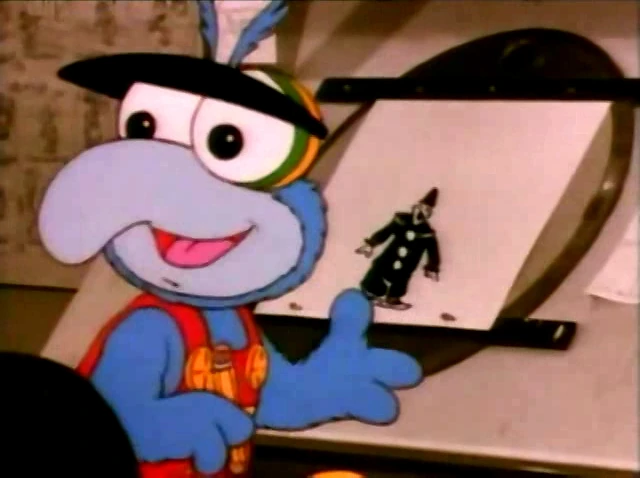

Gonzo gives birth to Koko the Clown
- The second season Muppet Babies episode "The Great Muppet Cartoon Show" features Baby Gonzo imagining his own cartoon studio, represented primarily through footage from Fleischer's Out of the Inkwell series. Gonzo struggles to bring Koko the Clown, the studio's first star, to life. Shots of various animators at work include close-ups of Max Fleischer himself.
- The sixth season Muppet Babies episode "Six to Eight Weeks" includes clips from several public domain Fleischer shorts, including Christmas Comes But Once a Year (1936).
- The Elmo's World episode on balls closes with Elmo encouraging the viewer to "Follow the bouncing ball." The concept, which has also been used in many sing-along videos, originated at the Fleischer studios. In 1926, along with brother Dave, Max Fleischer patented the "bouncing ball" technique, by which a small animated ball would bounce over the words, cueing both the audience and the theater organist, in the silent Song Car-Tunes series. In 1928, the concept was revived as Screen Songs, to take advantage of techniques afforded by the sound era, and incorporating such musical guest stars as Ethel Merman and Rudy Vallee.
- Several Elmo's World segments feature the Fleischer-esque cartoon character Bubbles Martin, whose eyes and hairdo recall Betty Boop.
- The Dog City "Episode 208: Old Dogs, New Tricks" featured old cartoon detective Sam Spayed, whose world resembles that of the Fleischer and other 1930s cartoon shorts.
Sources
- Barrier, Michael. Hollywood Cartoons: American Animation in Its Golden Age.
- Cabarga, Leslie. The Fleischer Story. Da Capo Press: 1976.